Preserving DEG Rankings for Gene Discovery in Histology-Based Spatial Gene Expression Prediction 🧬
Towards spatial gene expression prediction that prioritizes biologically meaningful gene discovery.
Overview
Task. Histology-based spatial gene expression prediction aims to estimate gene expression from tissue images, potentially enabling molecular analysis without direct gene measurements.
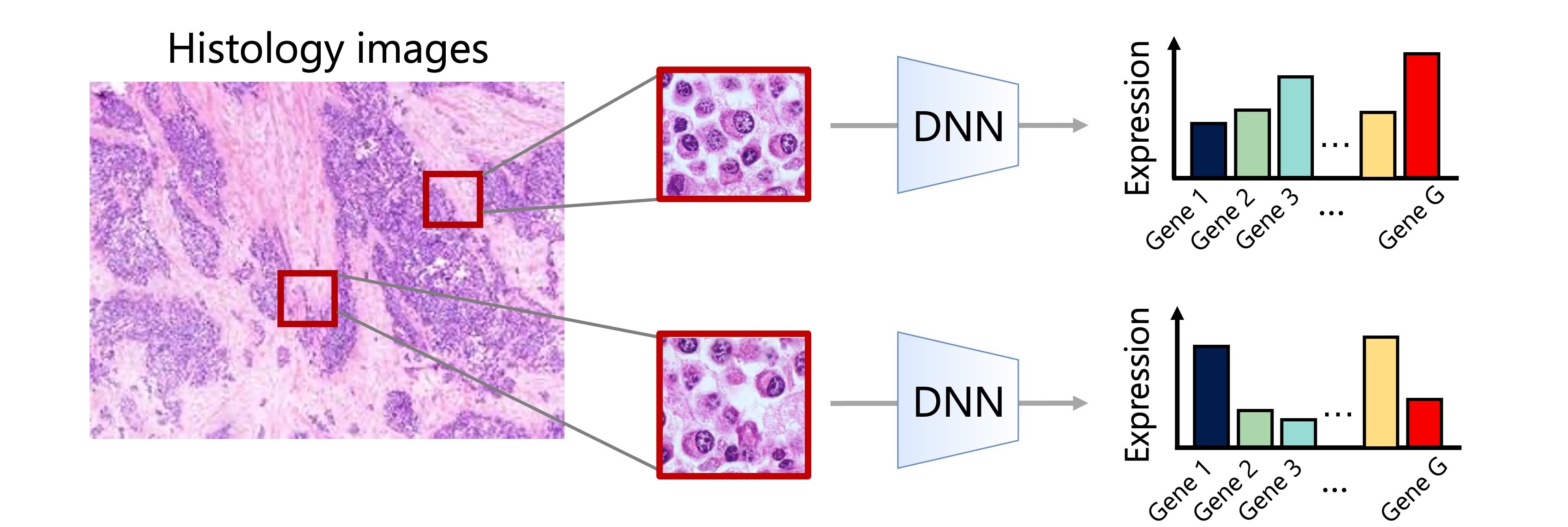
Predicting spatial gene expression from histology images.
Conventional approaches. Existing methods primarily focus on reconstructing the spatial expression patterns of individual genes. However, accurate reconstruction does not necessarily preserve the ranking of genes that distinguish different tissue regions.
Our approach (IDER). We introduce image-based differential expression ranking (IDER), which explicitly aims to preserve the ranking of genes based on their expression differences between tissue regions. By optimizing this ranking during training, IDER better supports downstream gene discovery.

assets/images/ider_concept.png
Abstract
Predicting spatial gene expression from histology images could scale spatial transcriptomics (ST) to image-only cohorts, but conventional histology-based ST prediction is trained and evaluated mainly by per-gene spatial-profile reconstruction. This objective is misaligned with a key downstream use of ST: differentially expressed gene (DEG) discovery, where genes are ranked for a biological or morphology-defined contrast by evidence of between-group expression differences. We formulate image-based differential expression ranking (IDER), which asks whether predicted expression profiles preserve the contrast-specific ranked gene list obtained from measured profiles. IDER compares gene rankings induced by differential-expression statistics, rather than raw expression magnitudes or per-gene spatial correlations. We further introduce a differentiable IDER objective that aligns these statistics across genes and can be trained with morphology-derived proxy contrasts without predefined biological group labels. Experiments on public ST datasets show improved DEG-ranking agreement and pathway-enrichment overlap over conventional reconstruction objectives, including morphology-derived and pathologist-annotated tissue-region evaluations.
Citation
@inproceedings{
shiku2026preserving,
title={Preserving {DEG} Rankings for Gene Discovery in Histology-Based Spatial Gene Expression Prediction},
author={Kaito Shiku and Kazuya Nishimura and Yasuhiro Kojima and Ryoma Bise},
booktitle={The Fortieth Annual Conference on Neural Information Processing Systems},
year={2026},
url={https://arxiv.org/abs/2609.33928}
}